

Provided by the American Apartment Owners Association
In property management, strong customer service is often praised as the key to successful leasing and resident retention. Leasing professionals are encouraged to be personable, attentive, and helpful in guiding prospects through the decision-making process. However, it is in these well-meaning interactions that one of the most common and costly fair housing risks can emerge: steering.
Steering rarely begins as an intentional act of discrimination. More often, it develops gradually, rooted in a desire to be helpful or to “make things easier” for a prospect. Understanding how customer service instincts can quietly turn into compliance issues is critical for housing providers seeking to operate ethically and in compliance with the law.
How Everyday Conversations Lead to Steering
Steering often occurs in casual, conversational moments. A leasing professional may recommend a specific building, floor plan, or area of a community based on assumptions about a prospect’s lifestyle, family size, age, or perceived needs. While the intent may be to enhance the customer experience, these assumptions can unintentionally limit choices and create unequal access to housing opportunities.
The ethical issue is not the information being shared, but how it is framed and why it is offered. When suggestions are driven by who a prospect is rather than what is available, customer service shifts into decision-making on behalf of the prospect. This is where the slope becomes slippery. Even subtle nudges, repeated over time, can establish patterns that expose a property management company to fair housing complaints.
Focusing on the Property, Not the Person
Ethical leasing practices require a deliberate shift in focus. Customer service should center on providing complete, accurate, and consistent information about the property itself. Features, amenities, pricing, availability, and policies should be presented uniformly, allowing prospects to decide what best fits their needs.
This approach protects both prospects and leasing professionals. By avoiding personalized recommendations based on perceived characteristics, housing providers reduce the risk of steering while still delivering a professional and respectful leasing experience. Letting prospects lead the decision-making process is not a lack of service; it is a safeguard that reinforces fairness and compliance.

A landlords one stop shop for tenant management…for FREE
You can’t beat free and the only time you pay is if you want to purchase a lease or have expedited rent deposits. Most everything else costs zip, zero, zilch.
Customer Service With Clear Boundaries
Strong customer service does not require bending rules or tailoring decisions based on assumptions about a prospect or resident. It requires clarity, consistency, and professionalism, especially in leasing interactions where steering risks are highest.
Steering-focused training should include practical examples such as how to respond when a prospect asks, “Where do families usually live?” or “Which building is quieter?” without making assumptions or narrowing choices. Role-based scenarios that show how to present all available units, redirect subjective questions back to objective property features, and allow prospects to self-select are especially effective.
When staff are trained to recognize how everyday phrasing, tone, or informal recommendations can influence housing decisions, they are far better equipped to deliver strong customer service while maintaining clear ethical and compliance boundaries.
Protecting Trust and Compliance
Steering remains one of the most subtle yet serious risks in property management, precisely because it can emerge from well-intentioned customer service. Recognizing this slippery slope allows housing providers to remain helpful and engaging while ensuring that access to housing choices is never influenced by assumptions or personal characteristics.
Ethical property management is not about reducing service or sacrificing personability. It is about delivering equal customer service—where every prospect and resident receives the same information, the same range of options, and the same level of professionalism. That consistency is what supports fair housing compliance, builds long-term trust, and defines true excellence in the property management profession.

Did you enjoy this article?
This is an example of what is included on our FREE weekly newsletter, Landlord Weekly.
Subscribers get access to our free forms, email templates, and guides! As well as…
▪️Landlord Tips ▪️ Early Access to Our Blogs ▪️ Landlord Specific Articles by Other Industry Pro’s ▪️ Podcast Links
By The Fair Housing Institute
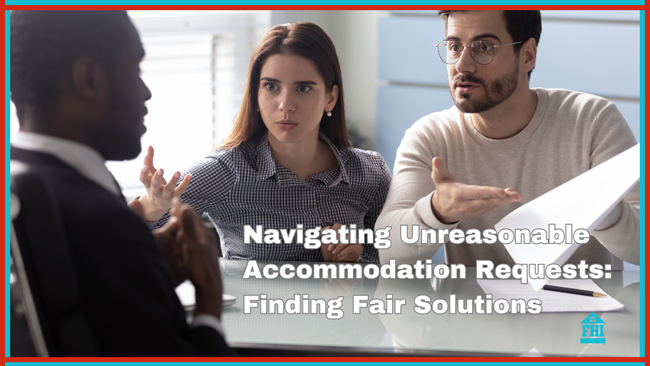
Unreasonable accommodation requests require special navigation of the issues by property managers who want to stay compliant with Fair Housing laws and find fair solutions.
The Fair Housing Act (FHA) requires property managers to provide reasonable accommodations for residents with disabilities to ensure equal access and enjoyment of their homes. However, not all requests are deemed reasonable.
Understanding how to navigate accommodation requests that may be considered unreasonable is essential for property managers who want to stay compliant with the law while also effectively managing their property.
What Makes an Accommodation Request Unreasonable?
An accommodation request is considered unreasonable if it places an undue financial or administrative burden on the property or fundamentally alters the nature of the property’s services. Determining whether a request is unreasonable requires property managers to assess several factors, including cost, available resources, and the impact on the property’s operations.
For example, a request for extensive structural modifications, such as installing an elevator in a small two-story building, may be deemed unreasonable due to the significant financial burden it would impose. Similarly, requests for personal services, such as requiring property staff to provide daily care for a resident, can be classified as unreasonable because they fundamentally alter the services typically provided by housing providers.
Examples of Unreasonable Accommodation Requests
- Undue financial burden: A resident requests modifications that require extensive construction, such as widening all hallways in a property to accommodate a larger wheelchair. For smaller properties with limited budgets, this request could impose an undue financial burden.
- Administrative strain: A resident asks for a 24/7 on-call maintenance service to accommodate their needs. This request could be considered unreasonable because it would require significant staffing adjustments that may not be feasible for the property-management team.
- Fundamental alterations: A request that requires the property to provide services beyond its typical offerings—such as providing specialized transportation or personal caregiving—is often classified as unreasonable. Property managers are not required to alter the fundamental nature of their operations to accommodate a resident.
The Interactive Process: Finding Alternatives
Even when a request is deemed unreasonable, property managers should not simply deny it and move on. Instead, the Fair Housing Act encourages managers to engage in an interactive process with the resident. The goal of this process is to explore alternative accommodations that meet the resident’s needs without imposing an undue burden on the property.
For instance, if a resident requests a modification that is too costly, such as installing a ramp at every entrance of the property, a reasonable alternative might be to install a ramp at one entrance that is accessible to the resident. Engaging in this kind of dialogue not only shows a willingness to accommodate but also helps ensure compliance with fair-housing regulations.
The interactive process should be approached with empathy and a genuine desire to find a solution. Documenting every conversation and action taken is critical, as it demonstrates that the property manager made an effort to accommodate the resident in a fair and reasonable way.

Need a Lease Agreement?
A FREE account gets you access to over 200 free forms. Upgrade to a paid account (monthly, annually, or lifetime)
EZLandlord Forms Is Offering 15% 𝙊𝙛𝙛 For New Customers!
We cannot recommend these guys enough!
👉 State Specific Leases 👉 400 Forms to make your landlord-tenant relationship top notch 👉 200 FREE forms for those not ready to purchase 👉 4.8 Rating with over 5000 Reviews 👉 Pro Members get access to ALL leases and forms for $12 per month OR $75 if you purchase the annual membership 👉 YOU CAN BUY LIFETIME FORMS for $399
USE CODE 𝐒𝐓𝐀𝐂𝐈𝐄𝟏𝟓 to get 15% OFF ALL first-time purchases, EVEN THE LIFETIME FORMS!
Consistency is Key
Property managers should establish consistent criteria for evaluating accommodation requests to maintain fairness and compliance with fair-housing laws. Every request must be assessed individually, but having clear guidelines helps ensure that decisions are made fairly and objectively.
Consistency can be maintained by:
- Creating written policies: Establishing clear, written policies regarding accommodation requests helps set expectations for residents and provides a consistent framework for property managers to follow.
- Training staff: Regular training on fair-housing requirements and the process for evaluating accommodation requests helps ensure that all staff members understand how to handle such requests consistently.
- Documenting decisions: Keeping detailed records of each request, the evaluation process, and any follow-up discussions or alternative accommodations offered is crucial. Documentation helps protect the property from liability if a resident claims their request was unfairly denied.
Best Practices for Navigating Unreasonable Requests
Engaging in dialogue with residents is crucial, even when a request seems unreasonable, as it helps to understand their needs and may lead to a minor modification or adjustment that resolves the issue without undue burden.
Being transparent is also important—communicating openly about why a particular request may be considered unreasonable helps set realistic expectations and prevents misunderstandings. If a request cannot be granted, offering alternative solutions demonstrates a willingness to work with the resident and can help avoid potential fair housing complaints.
Additionally, consulting legal counsel specializing in fair housing is advisable if there is any uncertainty about the reasonableness of a request or how to proceed.
Conclusion: Striving for Fair Solutions
Navigating unreasonable accommodation requests can be challenging, but by engaging in the interactive process, maintaining transparency, and striving for fair alternatives, property managers can create a more inclusive community while managing their responsibilities effectively. The key is to treat each request with care, document all actions, and remain committed to finding reasonable solutions wherever possible. By doing so, property managers not only uphold fair housing principles but also foster a community of trust and mutual respect.
Did you enjoy this article?
This is an example of what is included on our FREE weekly newsletter, Landlord Weekly.
Subscribers get access to our free forms, email templates, and guides! As well as…
▪️Landlord Tips ▪️ Early Access to Our Blogs ▪️ Landlord Specific Articles by Other Industry Pro’s ▪️ Podcast Links