
AFFILIATE DISCLOSURE: This post contains affiliate links. If you purchase QuickBooks through a link on this page, Your Landlord Resource may earn a commission at no additional cost to you. We only recommend tools we believe in.
Most small landlords think about taxes in February. By then, the year is already over — and so are most of the opportunities to do anything about any potential benefits that one would need to take advantage of during the tax year.
If you own one to three rental properties and you’re self-managing them, summer is actually one of the best times to get your financial house in order. You still have several months left in the tax year. That means if you discover you’re behind on tracking expenses, or you realize you could benefit from a repair versus improvement strategy, or you see that one of your properties isn’t performing the way you thought — you still have time to act.
Kevin and I have been self-managing our own rentals for years, and one of the tools that genuinely changed how we run our business is QuickBooks. We use it to invoice tenants for rent and fees directly, and when they pay, the deposit is automatically deposited into our bank account AND income is automatically coded and drops into the right place in our financials. Which means no manual entry, no reconciling at the end of the month, no wondering if something got missed. It keeps our books clean in real time, which means we’re never starting from scratch when tax season arrives.
QuickBooks is one of the most widely used small business accounting platforms available, and for landlords who want to run their rentals like a real business, it removes a lot of the friction that keeps people stuck in spreadsheet chaos or shoebox accounting. Here are three specific ways it can help you get organized now — while it still matters.
1. Get Your Expense Tracking Current Before You Forget What Everything Was For
If you’ve been meaning to log your receipts and categorize your rental expenses “later,” later has a way of becoming January — when you’re staring at six or twelve months of unrecognized charges and then trying to remember whether that Home Depot run was for your primary residence or the rental.
QuickBooks lets you connect your bank accounts and credit cards, so transactions import automatically. You then categorize them by type (repairs, utilities, insurance, property management, etc.) and assign them to the correct property. You can also snap photos of receipts directly from the mobile app and attach them to transactions, so everything lives in one place.
Getting your financials current now — in summer — means two things: First, the expenses are still fresh enough that you actually remember what they were. Second, you get a clear mid-year picture of where you stand, which sets up the next two points perfectly.
The tax-timing advantage: Legitimate rental expenses are generally deductible in the year they’re paid. If you’re not tracking them as they happen, you may be underreporting deductions without realizing it. Getting organized now means nothing falls through the cracks before December 31st.
Note: Always consult a qualified tax professional about what is deductible for your specific situation.

2. Run a Mid-Year Profit & Loss Report and Actually Understand Your Numbers
Once your expenses are current, QuickBooks makes it easy to run a Profit & Loss report — and this is where things get genuinely useful for a small landlord.
A P&L report shows you your rental income versus your expenses for any time period you choose. For a landlord with one to three properties, this answers questions like:
- Is this property actually making money after all expenses, or just generating gross rent?
- How much have I spent on repairs this year compared to last year?
- Am I on track with what I expected this property to net annually?
Most small landlords either don’t run these reports at all or only see them when their CPA puts together their tax return — which is too late to make decisions.
The tax-timing advantage: If your mid-year P&L shows you’re more profitable than expected, you may want to pull forward some planned expenses (like that HVAC service you’ve been putting off, or a fence repair) into this tax year rather than next. Conversely, if you’re showing a loss, understanding why gives you and your accountant something concrete to work with before year-end. Summer gives you a runway to make those calls — January does not.
Note: Tax strategy decisions should always be made in consultation with a licensed CPA or tax advisor.
3. Build a Clean Record Now So Year-End Isn’t a Crisis
For most small landlords, the weeks between Thanksgiving and New Year’s are not when they want to be digging through bank statements. But that’s exactly what happens when financial records aren’t kept up during the year.
QuickBooks creates an ongoing, organized record of your rental finances that your accountant can access directly — many CPAs work directly inside QuickBooks or accept QuickBooks files, which can significantly reduce the time (and cost) of tax preparation. When your books are clean and current, your tax professional can focus on strategy rather than data entry.
More importantly, having organized records now means you can have a meaningful conversation with your CPA in the fall — when there’s still time to implement any recommendations before the tax year closes.
The tax-timing advantage: Year-end tax planning meetings with accountants tend to be more productive — and more actionable — when the client walks in with organized financials. If you wait until January or February, you’re doing a post-mortem. If you show up in October or November with clean QuickBooks records, you’re doing planning.
Don’t Wait Until the Holidays to Start Organizing Last Year’s Mess
The landlords who feel most on top of their rental business aren’t necessarily the ones with the most properties or the most experience. They’re often just the ones who built simple, consistent systems for tracking their finances throughout the year.
Summer is the ideal time to build that habit — or catch up if you’ve fallen behind. QuickBooks makes it accessible even if accounting isn’t your strength, and the payoff at tax time — and throughout the year — is real.
Click HERE to learn more about how Quickbooks can help you with your rental property accounting needs.
AFFILIATE DISCLOSURE: This post contains affiliate links. If you purchase QuickBooks through a link on this page, Your Landlord Resource may earn a commission at no additional cost to you. We only recommend tools we believe in.

Did you enjoy this article?
This is an example of what is included on our FREE weekly newsletter, Landlord Weekly.
Subscribers get access to our free forms, email templates, and guides! As well as…
▪️Landlord Tips ▪️ Early Access to Our Blogs ▪️ Landlord Specific Articles by Other Industry Pro’s ▪️ Podcast Links
Listen On:


If you’ve never had a smoking tenant, consider yourself lucky — and unprepared. A smoking policy for landlords isn’t just a nice-to-have anymore. It’s the industry standard, and for good reason. In this episode of the Your Landlord Resource Podcast, Kevin and I are talking about what happens when you don’t have one, why the definition of ‘smoking’ has completely changed over the last five years, and exactly what to do — in your lease and in real life — if a tenant lights up in your rental.
Smoke-free housing has become the norm. Most professional property managers and large landlords have already adopted it as standard policy. But if you’re a self-managing landlord who inherited a lease from years ago, or who never formalized the language, you may have gaps you don’t even know about. Cannabis is legal in California and many other states — but that doesn’t mean a tenant has the right to smoke it inside your rental. Vaping is everywhere. And a lease that only says ‘no cigarettes’ doesn’t come close to covering today’s reality.
Smoking Policy for Landlords: Does Property Type Matter?
Here’s something that often gets overlooked: the stakes are different depending on what kind of property you own. If you have a single-family home, your primary risks are financial and fire-related. But the moment you move into a duplex or multi-unit building, you’re dealing with shared walls, shared HVAC systems, and secondhand smoke that does not respect lease boundaries. At our Sacramento six-plex, this is not a theoretical concern. Smoke travels through electrical outlets, plumbing chases, and ventilation — and when a non-smoking tenant is exposed to it in their own home, they may have grounds to claim a breach of the implied warranty of habitability. That means rent withholding, lease termination, or worse. The bigger the building, the higher the legal liability.
What Smoking Actually Costs You at Turnover
We hear it all the time: ‘I’ll just keep their deposit if there’s smoke damage.’ That’s not how it works. The financial damage from a long-term smoking tenant — nicotine on every surface, stained walls, destroyed carpeting, contaminated HVAC ductwork — almost always exceeds a standard security deposit. In California, that deposit is capped at one month’s rent. Remediation requires specialized primer like Kilz before you can even think about repainting, plus carpet replacement, duct cleaning, and more. We share a personal story in this episode that makes that cost very, very real.
How to Write the Clause — and Enforce It
Your no-smoking lease clause needs to define exactly what’s prohibited — cigarettes, cigars, pipes, e-cigarettes, vaping devices, and cannabis. It needs to say where it applies, extend to guests, and spell out the consequences. And if you discover a tenant is violating it? The process is: document first, then put it in writing. The lease does the talking. Your job is to follow the process — not get into an argument. We walk through all of it in this episode.
We also reference our last episode (EP128) where we used AI to help strengthen Kid 2’s lease language around smoke remediation — a great example of how these tools work together. If you haven’t listened to that one yet, it’s linked in the resources below.
What You’ll Learn in This Episode
- Why a smoking policy for landlords is now the industry standard — and what’s changed in the last five years that makes older leases dangerously incomplete
- How property type changes everything: single-family home vs. duplex vs. multi-unit building — and what the legal liability looks like at each level
- What today’s ‘no smoking’ clause actually needs to cover: cigarettes, cigars, pipes, e-cigarettes, vaping devices, and cannabis — and why leaving any of them out creates real gaps
- Why smokers are not a legally protected class — and what that means for your screening and lease enforcement
- The real financial cost of smoking damage at turnover: why a security deposit almost never covers it, and what you’re actually looking at in remediation costs
- The four things your lease no-smoking clause must do: define what’s prohibited, define where it applies, extend it to guests, and specify consequences
- What to do when you discover a tenant is smoking in violation of the lease — the step-by-step process from documentation to Notice to Cure or Quit
- Why you cannot add a no-smoking clause mid-lease — and when the right window is to introduce new lease terms
- A real story from our Sacramento six-plex involving a tenant who smoked outside during COVID — and the documentation process that followed
- Why move-in photos and written checklists are your only leverage when a smoking dispute goes to small claims court
LINKS & REFERENCES MENTIONED IN THIS EPISODE
EP128 AI Is Your New Business Partner
American Nonsmokers’ Rights Foundation
ChangeLab Solutions (Smoke-Free Housing Resources)
EZ Landlord Forms State Specific Leases for Landlords
Connect with Us:
🌎 Visit our website
📧 Subscribe to our newsletter.
👆Click this LINK to select from our FREE Landlord Forms and Doc’s
🤳Text Us SMS text to 650-489-4447. We love questions and love letters, hate mail not so much!
📩Email us at: Stacie@YourLandlordResource.com, Kevin@YourLandlordResource.com
✔️Course Waitlist: From Marketing to Move In, Place Your Ideal Tenant
📱 Follow us on Instagram, Facebook, & join our private Facebook group
🎧 Listen & Subscribe on Apple Podcasts, Spotify, or your favorite podcast app
*This post contains affiliate links. We may earn a very small commission (at no additional cost to you) if you purchase from here. These small commissions are to benefit our business so thank you for your support.
Estimated reading time: 3 minutes

Provided by the American Apartment Owners Association
In property management, strong customer service is often praised as the key to successful leasing and resident retention. Leasing professionals are encouraged to be personable, attentive, and helpful in guiding prospects through the decision-making process. However, it is in these well-meaning interactions that one of the most common and costly fair housing risks can emerge: steering.
Steering rarely begins as an intentional act of discrimination. More often, it develops gradually, rooted in a desire to be helpful or to “make things easier” for a prospect. Understanding how customer service instincts can quietly turn into compliance issues is critical for housing providers seeking to operate ethically and in compliance with the law.
How Everyday Conversations Lead to Steering
Steering often occurs in casual, conversational moments. A leasing professional may recommend a specific building, floor plan, or area of a community based on assumptions about a prospect’s lifestyle, family size, age, or perceived needs. While the intent may be to enhance the customer experience, these assumptions can unintentionally limit choices and create unequal access to housing opportunities.
The ethical issue is not the information being shared, but how it is framed and why it is offered. When suggestions are driven by who a prospect is rather than what is available, customer service shifts into decision-making on behalf of the prospect. This is where the slope becomes slippery. Even subtle nudges, repeated over time, can establish patterns that expose a property management company to fair housing complaints.
Focusing on the Property, Not the Person
Ethical leasing practices require a deliberate shift in focus. Customer service should center on providing complete, accurate, and consistent information about the property itself. Features, amenities, pricing, availability, and policies should be presented uniformly, allowing prospects to decide what best fits their needs.
This approach protects both prospects and leasing professionals. By avoiding personalized recommendations based on perceived characteristics, housing providers reduce the risk of steering while still delivering a professional and respectful leasing experience. Letting prospects lead the decision-making process is not a lack of service; it is a safeguard that reinforces fairness and compliance.

A landlords one stop shop for tenant management…for FREE
You can’t beat free and the only time you pay is if you want to purchase a lease or have expedited rent deposits. Most everything else costs zip, zero, zilch.
Customer Service With Clear Boundaries
Strong customer service does not require bending rules or tailoring decisions based on assumptions about a prospect or resident. It requires clarity, consistency, and professionalism, especially in leasing interactions where steering risks are highest.
Steering-focused training should include practical examples such as how to respond when a prospect asks, “Where do families usually live?” or “Which building is quieter?” without making assumptions or narrowing choices. Role-based scenarios that show how to present all available units, redirect subjective questions back to objective property features, and allow prospects to self-select are especially effective.
When staff are trained to recognize how everyday phrasing, tone, or informal recommendations can influence housing decisions, they are far better equipped to deliver strong customer service while maintaining clear ethical and compliance boundaries.
Protecting Trust and Compliance
Steering remains one of the most subtle yet serious risks in property management, precisely because it can emerge from well-intentioned customer service. Recognizing this slippery slope allows housing providers to remain helpful and engaging while ensuring that access to housing choices is never influenced by assumptions or personal characteristics.
Ethical property management is not about reducing service or sacrificing personability. It is about delivering equal customer service—where every prospect and resident receives the same information, the same range of options, and the same level of professionalism. That consistency is what supports fair housing compliance, builds long-term trust, and defines true excellence in the property management profession.
Did you enjoy this article?
This is an example of what is included on our FREE weekly newsletter, Landlord Weekly.
Subscribers get access to our free forms, email templates, and guides! As well as…
▪️Landlord Tips ▪️ Early Access to Our Blogs ▪️ Landlord Specific Articles by Other Industry Pro’s ▪️ Podcast Links
By The Fair Housing Institute
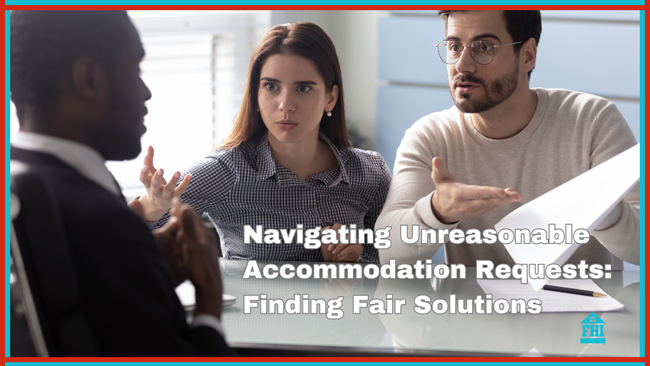
Unreasonable accommodation requests require special navigation of the issues by property managers who want to stay compliant with Fair Housing laws and find fair solutions.
The Fair Housing Act (FHA) requires property managers to provide reasonable accommodations for residents with disabilities to ensure equal access and enjoyment of their homes. However, not all requests are deemed reasonable.
Understanding how to navigate accommodation requests that may be considered unreasonable is essential for property managers who want to stay compliant with the law while also effectively managing their property.
What Makes an Accommodation Request Unreasonable?
An accommodation request is considered unreasonable if it places an undue financial or administrative burden on the property or fundamentally alters the nature of the property’s services. Determining whether a request is unreasonable requires property managers to assess several factors, including cost, available resources, and the impact on the property’s operations.
For example, a request for extensive structural modifications, such as installing an elevator in a small two-story building, may be deemed unreasonable due to the significant financial burden it would impose. Similarly, requests for personal services, such as requiring property staff to provide daily care for a resident, can be classified as unreasonable because they fundamentally alter the services typically provided by housing providers.
Examples of Unreasonable Accommodation Requests
- Undue financial burden: A resident requests modifications that require extensive construction, such as widening all hallways in a property to accommodate a larger wheelchair. For smaller properties with limited budgets, this request could impose an undue financial burden.
- Administrative strain: A resident asks for a 24/7 on-call maintenance service to accommodate their needs. This request could be considered unreasonable because it would require significant staffing adjustments that may not be feasible for the property-management team.
- Fundamental alterations: A request that requires the property to provide services beyond its typical offerings—such as providing specialized transportation or personal caregiving—is often classified as unreasonable. Property managers are not required to alter the fundamental nature of their operations to accommodate a resident.
The Interactive Process: Finding Alternatives
Even when a request is deemed unreasonable, property managers should not simply deny it and move on. Instead, the Fair Housing Act encourages managers to engage in an interactive process with the resident. The goal of this process is to explore alternative accommodations that meet the resident’s needs without imposing an undue burden on the property.
For instance, if a resident requests a modification that is too costly, such as installing a ramp at every entrance of the property, a reasonable alternative might be to install a ramp at one entrance that is accessible to the resident. Engaging in this kind of dialogue not only shows a willingness to accommodate but also helps ensure compliance with fair-housing regulations.
The interactive process should be approached with empathy and a genuine desire to find a solution. Documenting every conversation and action taken is critical, as it demonstrates that the property manager made an effort to accommodate the resident in a fair and reasonable way.

Need a Lease Agreement?
A FREE account gets you access to over 200 free forms. Upgrade to a paid account (monthly, annually, or lifetime)
EZLandlord Forms Is Offering 15% 𝙊𝙛𝙛 For New Customers!
We cannot recommend these guys enough!
👉 State Specific Leases 👉 400 Forms to make your landlord-tenant relationship top notch 👉 200 FREE forms for those not ready to purchase 👉 4.8 Rating with over 5000 Reviews 👉 Pro Members get access to ALL leases and forms for $12 per month OR $75 if you purchase the annual membership 👉 YOU CAN BUY LIFETIME FORMS for $399
USE CODE 𝐒𝐓𝐀𝐂𝐈𝐄𝟏𝟓 to get 15% OFF ALL first-time purchases, EVEN THE LIFETIME FORMS!
Consistency is Key
Property managers should establish consistent criteria for evaluating accommodation requests to maintain fairness and compliance with fair-housing laws. Every request must be assessed individually, but having clear guidelines helps ensure that decisions are made fairly and objectively.
Consistency can be maintained by:
- Creating written policies: Establishing clear, written policies regarding accommodation requests helps set expectations for residents and provides a consistent framework for property managers to follow.
- Training staff: Regular training on fair-housing requirements and the process for evaluating accommodation requests helps ensure that all staff members understand how to handle such requests consistently.
- Documenting decisions: Keeping detailed records of each request, the evaluation process, and any follow-up discussions or alternative accommodations offered is crucial. Documentation helps protect the property from liability if a resident claims their request was unfairly denied.
Best Practices for Navigating Unreasonable Requests
Engaging in dialogue with residents is crucial, even when a request seems unreasonable, as it helps to understand their needs and may lead to a minor modification or adjustment that resolves the issue without undue burden.
Being transparent is also important—communicating openly about why a particular request may be considered unreasonable helps set realistic expectations and prevents misunderstandings. If a request cannot be granted, offering alternative solutions demonstrates a willingness to work with the resident and can help avoid potential fair housing complaints.
Additionally, consulting legal counsel specializing in fair housing is advisable if there is any uncertainty about the reasonableness of a request or how to proceed.
Conclusion: Striving for Fair Solutions
Navigating unreasonable accommodation requests can be challenging, but by engaging in the interactive process, maintaining transparency, and striving for fair alternatives, property managers can create a more inclusive community while managing their responsibilities effectively. The key is to treat each request with care, document all actions, and remain committed to finding reasonable solutions wherever possible. By doing so, property managers not only uphold fair housing principles but also foster a community of trust and mutual respect.
Did you enjoy this article?
This is an example of what is included on our FREE weekly newsletter, Landlord Weekly.
Subscribers get access to our free forms, email templates, and guides! As well as…
▪️Landlord Tips ▪️ Early Access to Our Blogs ▪️ Landlord Specific Articles by Other Industry Pro’s ▪️ Podcast Links
Listen On:
What if you had a business advisor on call at two in the morning when your tenant sends a threatening email, your insurance company denies a claim, or you need to know your rights before calling your attorney the next day? That advisor exists — and it’s AI. In this episode of the Your Landlord Resource Podcast, Kevin and I get real about how we use artificial intelligence in our own rental property business, share the specific moments where it saved us time, money, and a lot of stress, and walk you through exactly how to use it yourself.
We cover two real stories that changed how we think about AI as a landlord tool. The first involves a domestic violence situation at our Sacramento 6-plex, where uploading our actual lease to ChatGPT at eleven o’clock at night gave us a detailed, clause-by-clause analysis of our options before we ever called our attorney — who couldn’t add a single thing to what AI had already told us. The second involves a landlord in our community who used AI to find buried language in their insurance policy after a tree removal claim was denied, and recovered thousands of dollars as a result. Both stories come down to the same thing: having the right information at the right time changes everything.
Beyond the stories, we break down six practical categories where AI is making a real difference for self-managing landlords: document analysis, tenant communication, financial analysis, legal and compliance research, maintenance triage, and staying current on landlord-tenant law. We also walk through the third-story review of Kid 2’s Idaho duplex lease — where AI caught confusing utility billing language, missing ESA acknowledgment, vaping and smoke remediation clauses, a plumbing liability gap, and a winter vacancy notification requirement that could have meant frozen pipes.
One of my favorite parts of this episode is the prompting segment, because it’s where most people get stuck. The quality of what AI gives you is almost entirely determined by what you give it. We teach you the four-element prompt framework — Role, Context, Document, and Output — and share word-for-word example prompts you can use for lease analysis, insurance claim denials, contractor bids, and tenant communications. You’ll be able to use these the same day you listen.
We also address the one thing that stops a lot of landlords from trusting AI: accuracy. AI can be wrong, and we don’t sugarcoat that. We explain what hallucination means, why AI’s knowledge has a cutoff date, and — most importantly — how to prompt AI specifically so it flags its own uncertainty instead of filling gaps with confident guesses. We even share the truth protocol we added to our own AI settings to keep answers grounded in verified, citable information. AI is not your attorney, your CPA, or your insurance professional. But used correctly, it will make every conversation you have with those professionals more informed, more efficient, and a lot less expensive.
WHAT YOU’LL LEARN IN THIS EPISODE
- How Kevin and Stacie used AI on a domestic violence lease situation — and what a one-hour session revealed that matched their attorney and the California Apartment Association almost verbatim
- How a landlord in their community used AI to recover thousands in a denied insurance tree-removal claim by finding buried policy language
- The six practical categories where AI delivers real value for self-managing landlords: document analysis, tenant communication, financial analysis, legal research, maintenance triage, and staying current
- How Stacie used Claude AI to evaluate a 34-unit building purchase using her actual financial profile — and what it revealed about her investment position
- How AI reviewed Kid 2’s Idaho duplex lease and caught seven critical gaps including ESA language, vaping clauses, plumbing liability transfer, utility billing confusion, and a winter vacancy notification requirement
- The four-element prompt framework — Role, Context, Document, Output — and why vague questions get vague answers
- Word-for-word example prompts you can use right now for lease analysis, insurance denials, contractor bids, and tenant communications
- What AI hallucination means and why it matters for landlords asking legal or insurance questions
- How to prompt AI to flag its own uncertainty instead of guessing — including four specific accuracy prompts
- The truth protocol Stacie added to her AI settings — and how to set it up in ChatGPT and Claude
- Why AI is a first-pass tool, not a final authority — and how to use it to show up to attorney and CPA meetings better prepared and more efficient
- What to upload (and what never to upload) when using AI with sensitive rental documents
LINKS & REFERENCES MENTIONED IN THIS EPISODE
Episode 20 – The Nuts and Bolts of Residential Rental Property Insurance
EZ Landlord Forms – State-specific lease templates mentioned in the episode – https://www.ezlandlordforms.com
ChatGPT – https://chat.openai.com
Claude AI – https://claude.ai
Connect with Us:
🌎 Visit our website
📧 Subscribe to our newsletter.
👆Click this LINK to select from our FREE Landlord Forms and Doc’s
🤳Text Us SMS text to 650-489-4447. We love questions and love letters, hate mail not so much!
📩Email us at: Stacie@YourLandlordResource.com, Kevin@YourLandlordResource.com
✔️Course Waitlist: From Marketing to Move In, Place Your Ideal Tenant
📱 Follow us on Instagram, Facebook, & join our private Facebook group
🎧 Listen & Subscribe on Apple Podcasts, Spotify, or your favorite podcast app
*This post contains affiliate links. We may earn a very small commission (at no additional cost to you) if you purchase from here. These small commissions are to benefit our business so thank you for your support.
Estimated reading time: 3 minutes
Listen On:
You know the neighborhood when you buy. But do you really know it now that you own and manage the property?
In this Shorty episode of the Your Landlord Resource Podcast, Kevin and Stacie take a topic they first introduced in Episode 23 and go deeper — moving beyond marketing copy to explore what it truly means to understand the neighborhood surrounding your rental property.
From discovery walks and walk scores to fair housing guardrails and tenant retention, this conversation is packed with practical insights that help self-managing landlords become more confident, more informed, and more competitive in their local rental market.
WHAT YOU’LL LEARN IN THIS EPISODE
- Why tenants rent a lifestyle — not just a unit — and how knowing your neighborhood helps you speak to that
- How neighborhood knowledge gives you a competitive edge during showings without following people around
- What to say (and what never to say) when a prospective tenant asks “What’s the neighborhood like?” — and why fair housing certification matters
- The discovery walk habit and why doing it at different times of day reveals an entirely different neighborhood
- The Sacramento midtown story: what a late-night walk taught Kevin and Stacie about their own rental area
- Walk Score, Bike Score, and the EPA National Walkability Index — free tools and their limitations
- The six neighborhood categories every landlord should know: walkability, entertainment and leisure, schools and family amenities, transportation and parking, major employers, and safety indicators
- Why co-working proximity has become a genuine amenity in the hybrid work era
- How neighborhood awareness sharpens your rent pricing decisions
- Using neighborhood knowledge during tenant onboarding and move-in — not just at showings
- Why being a plugged-in landlord builds long-term tenant retention
- Practical tactics: how to actually do the research, from local social media to Chamber of Commerce connections
LINKS & REFERENCES MENTIONED IN THIS EPISODE
Episode 23 – Tips On Marketing Your Rental Property, Part 1
Read our Blog: Know Your Rental Neighborhood
EPA National Walkability Index
SpotCrime – Public Crime Data
Fair Housing Institute – Certification Courses (Use Code: YLR26 for 20% off first order)
Connect with Us:
🌎 Visit our website
📧 Subscribe to our newsletter.
👆Click this LINK to select from our FREE Landlord Forms and Doc’s
🤳Text Us SMS text to 650-489-4447. We love questions and love letters, hate mail not so much!
📩Email us at: Stacie@YourLandlordResource.com, Kevin@YourLandlordResource.com
✔️Course Waitlist: From Marketing to Move In, Place Your Ideal Tenant
📱 Follow us on Instagram, Facebook, & join our private Facebook group
🎧 Listen & Subscribe on Apple Podcasts, Spotify, or your favorite podcast app
*This post contains affiliate links. We may earn a very small commission (at no additional cost to you) if you purchase from here. These small commissions are to benefit our business so thank you for your support.
Estimated reading time: 3 minutes

Provided by The Fair Housing Institute
As the demand for housing continues to rise, property managers face the dual responsibility of maintaining occupancy standards and adhering to fair housing regulations. Occupancy limits are a fundamental tool used to ensure the safety, comfort, and well-being of residents while safeguarding property integrity. However, enforcing these limits while remaining compliant with fair housing laws can present challenges, particularly when requests for reasonable accommodation are involved.
This article explores the critical role of occupancy limits, the legal framework governing their enforcement, and the considerations property managers must account for when handling requests for exceptions.
The Importance of Occupancy Limits
Occupancy limits are established to maintain safety standards and prevent overcrowding in rental units. These limits are typically based on state and local housing codes, which take into account factors such as the square footage of a unit, the availability of exits, and the capacity of essential systems such as plumbing and ventilation. But what does enforcing these types of limits ensure for properties?
Enforcing occupancy limits is essential for ensuring safety compliance, as overcrowded units can pose significant risks, including increased fire hazards, restricted emergency access, and excessive strain on the property’s infrastructure. Additionally, occupancy limits help maintain the quality of life for all residents by minimizing noise, preventing property damage, and reducing wear and tear on shared amenities. Lastly, adhering to legal guidelines for occupancy limits not only helps preserve the well-being of the community but also shields property owners and managers from potential legal disputes and costly penalties.
While occupancy limits are essential for these reasons, property managers must enforce them in a manner that also aligns with federal fair housing laws.
Enforcing Occupancy Limits: Key Considerations
When enforcing occupancy limits, property managers must approach the task with professionalism and an understanding of both their legal obligations and the rights of residents under fair housing regulations. The following considerations will help guide enforcement in a fair and compliant manner:
1. Can Occupancy Limits Be Enforced?
Yes, property managers are within their rights to enforce occupancy limits, as long as these limits are clearly defined in the lease agreement and compliant with state and local regulations. However, it is important to recognize that exceptions may arise in the context of fair housing laws. For example, residents may request reasonable accommodations that necessitate a deviation from the set occupancy limits.
2. How Should Suspected Violations Be Addressed?
When a property manager suspects that a unit is housing more occupants than allowed, the first step is to confirm the facts. This involves engaging with the residents to discuss the terms of the lease and the occupancy policy. Should a violation be confirmed, it is necessary to proceed with addressing the issue as a lease violation. However, property managers must remain open to the possibility that a request for reasonable accommodation may alter the course of action.
3. What Practices Should Be Avoided?
To avoid potential fair housing violations, property managers should refrain from inquiring about the composition of the household in terms of familial status (i.e., whether there are children in the home). The focus should remain on the number of individuals residing in the unit, as family status is a protected category under fair housing law. Unless your occupancy policy explicitly excludes infants from the count, conversations should strictly center on the number of occupants in relation to the lease agreement.
4. Can Residents Request a Reasonable Accommodation?
Yes, federal fair housing law allows residents to request reasonable accommodations to occupancy limits, even if those limits are established by local ordinances. For example, if a resident requires live-in care due to a disability, the property manager may need to allow an additional occupant in the unit beyond the standard limit. When local regulations and federal civil rights laws conflict, federal law takes precedence.
Need a Lease Agreement?
A FREE account gets you access to over 200 free forms. Upgrade to a paid account (monthly, annually, or lifetime)
EZLandlord Forms Is Offering 15% 𝙊𝙛𝙛 For New Customers!
We cannot recommend these guys enough!
👉 State Specific Leases 👉 400 Forms to make your landlord-tenant relationship top notch 👉 200 FREE forms for those not ready to purchase 👉 4.8 Rating with over 5000 Reviews 👉 Pro Members get access to ALL leases and forms for $12 per month OR $75 if you purchase the annual membership 👉 YOU CAN BUY LIFETIME FORMS for $399
USE CODE 𝐒𝐓𝐀𝐂𝐈𝐄𝟏𝟓 to get 15% OFF ALL first-time purchases, EVEN THE LIFETIME FORMS!
Balancing Enforcement and Fair Housing Obligations
Enforcing occupancy limits is a necessary aspect of property management, but it must be done with an awareness of legal obligations under federal fair housing laws. By ensuring that occupancy limits are fairly applied and that reasonable accommodation requests are carefully considered, property managers can navigate this complex issue with confidence.
Reviewing occupancy policies regularly, staying updated on changes to housing laws, and providing ongoing training for staff are essential steps in maintaining compliance and fostering an inclusive and safe residential community.
In conclusion, property managers must find the right balance between enforcing occupancy limits for the benefit of all residents and accommodating individual needs under fair housing law. By maintaining open communication and staying informed of legal developments, property managers can ensure their policies are both effective and equitable.
Did you enjoy this article?
This is an example of what is included on our FREE weekly newsletter, Landlord Weekly.
Subscribers get access to our free forms, email templates, and guides! As well as…
▪️Landlord Tips ▪️ Early Access to Our Blogs ▪️ Landlord Specific Articles by Other Industry Pro’s ▪️ Podcast Links

Stephen Michael White
Looking for marketing ideas to help you fill an apartment vacancy quickly? Maximize your rental property’s potential with our top marketing strategies. Discover how to fill vacancies fast, attract quality tenants, and enhance your apartment’s appeal in a competitive market. Turn your rental challenges into opportunities with our expert guide.
Key Takeaways
- Diverse Marketing Channels: Utilize a mix of advertising methods, including online listings, traditional signs, and word of mouth, to reach a broad audience.
- Engagement and Communication: Clearly articulate the benefits and features of your rental property to potential tenants, highlighting amenities and the local community.
- Strategic Pricing: Ensure your rental price is competitive within the local market to attract and retain tenants.
- Property Presentation: Keep the rental property well-maintained and attractive to prospective tenants, making a good first impression.
- Tenant Screening: Aim for quality over speed in tenant selection to ensure long-term stability and reduce turnover rates.
Finding the right tactics to market a new property is difficult, but filling vacancies is essential for any successful rental business.
A vacant rental property is like a pimple on the complexion of your real estate investment business—it’s all you can think about when it’s there, and you feel so much better when it’s gone!
Rental vacancies go even deeper. The longer you have vacancies you can’t fill, the more your bottom line suffers. Filling empty units is vital for long-term success, so finding the right strategies for your target market is essential.
Today, learn about five great ideas for marketing rental property that will fill your rental vacancies quickly.
Why Marketing Matters
For many new landlords, rental property marketing is something they have never had to do before. However, even more experienced landlords might still be searching for ways to successfully advertise an apartment for rent.
Before we learn the techniques that are helping landlords worldwide fill vacancies, consider why marketing should be a crucial element of your rental business.
Reduce Costs
When you have a vacant rental property, it costs you money every day that it sits empty, so it’s important to reduce that time between qualified, paying tenants to the bare minimum.
This is one of the most important reasons you should focus on rental property marketing in the early development stages of your business. Filling properties with good tenants can be challenging, but you want to ensure that you have a system to make this as efficient as possible.
Finding Good Tenants
While finding good tenants isn’t always the first thing on your mind when trying to fill a rental unit quickly, it is still an essential aspect of marketing. The more applicants you have for a property, the more likely you will find a good fit.
However, filling a vacant unit with good tenants takes more than printing neighborhood flyers.
How to Market Your Apartment for Rent: A Simple Guide
Once it is time to start marketing, there’s more to do than post your property in the right places. When learning how to market your apartment for rent, there are a few more things to know, including which method you use to market your vacant rental property.
Attend to The Rental Property
The rental property itself needs to be as attractive as possible. How much you can do and how early depends on whether an existing tenant currently occupies the unit or whether you are dealing with an already vacant unit. If the rental unit is currently occupied, coordinate with the tenant for a move-out inspection to get a good idea of what kinds of repairs and updates you’ll need.
It’s also an excellent time to photograph the rental property for your marketing efforts. Make a list of all the tasks you’ll need to do or manage to get the rental property in top shape.
Then, schedule services and maintenance the day after the tenant moves out so you don’t postpone a new tenant’s move-in date. Schedule the painters, carpet cleaners, and any other outside services as soon as you can so that the rental unit is move-in ready just a few days after being vacated.
With a rental property that is already vacant, you must still work quickly to get those outside services to transform the unit into something you can show prospective tenants as soon as possible. Remember that every day your rental property sits empty translates into zero income for you, so pressure everyone, including yourself, to get the property rent-ready.
Vacancy Tip:
Photographs of clean, empty rental units are generally more appealing to prospective tenants than photos of someone else’s furniture and belongings.
If you don’t have any photos of the empty rental property to use for your current marketing efforts, make sure you take the time during this transition to get some quality shots before the new tenants move in. You can keep these photographs on file to use the next time you need to fill a vacancy, saving yourself some time and hassle.
Write Enticing Marketing Copy
When advertising your rental property, your words and the features you highlight will motivate prospective tenants to contact you. Paired with good property photographs, the right marketing copy will tell applicants everything they want to know and help screen out people who wouldn’t be interested in your rental.
Make a list of all the features your rental property offers. Note the obvious things like the number of bedrooms and bathrooms and other details like the size, rent and deposit amounts, pet policy, location, and contact information.
List your property’s amenities and best features, such as laundry hookups, air conditioning, a pool, or new carpet. Then, think outside the box and decide what makes your property unique. In other words, what type of tenant would be attracted to it?
For example, mention that the property has easy freeway access or is close to downtown to attract younger professionals. You could list the elementary, junior high, and high schools for your single-family rental property to attract those with kids. Include anything you think might make your advertisement stand out from all the similar ones.
Vacancy Tip:
Nothing grabs attention better than the promise of a sale, discount, or other financial perks, so consider including that in your marketing copy headline. Examples include $100 off the first month’s rent, free six-month cable, or a $100 gift card upon signing a lease agreement.
Although it may seem counterintuitive to put up some of your own money or slash rent, it is a small price to pay to get the attention of prospective tenants and motivate them to choose your rental property over another.
Choose Your Advertising Avenues
Once ready to market your vacant rental unit and have the photos and copy, consider your best marketing sources to deliver the message to the correct recipients.
To get maximum exposure, post your advertisement in as many free places as possible and as many paid-for places as is reasonable and affordable.
Marketing a vacancy means making as many qualified applicants as possible aware that your property is ready and waiting for them. There are several options for both free and paid marketing campaigns. Free marketing means that it either takes no money or a minuscule amount to market your rental vacancy, while other marketing efforts may cost you to use their services.
Beyond those free sources, consider how much it costs to hold onto vacancies versus how much it would cost you to do paid advertising. This will allow you to see if your budget has reasonable space for paid advertising to bring new eyes to your rental properties.
Here are five great marketing ideas that will fill rental vacancies quickly:
- Word of mouth: Sometimes, other tenants can be your best free resource when finding potential tenants. Let your other tenants know that you have a vacancy available, and let them spread the word among family, friends, and co-workers. You can even throw in a finder’s fee for a good referral, such as a discount on rent or a gift card.
- Signs: Even if it seems cliché, putting up one or two “For Rent” signs can capture local traffic like nothing else. Put a sign in a prominent window or even on the front lawn to get the attention of pedestrians and motorists who frequent your neighborhood.
- Online listing sites: Many well-known websites with local market classifieds, including Craigslist and Zillow, are free. Look around for local or regional sites that include apartment and rental property listings, too. Social media platforms, especially Facebook Marketplace, is another good option.
- Online newspaper ads: Most newspapers have added an online version and still offer listings for a range of things, such as jobs, pets for sale, homes for sale, and rental vacancies. Check out your city or region’s local newspaper online and see what it would take to list your property. Most newspapers charge a nominal fee for a set timeframe. Usually, you can easily extend the listing if you have not found the right tenants.
- Local rental and real estate offices: It’s common for more prominent real estate offices to handle rentals and their advertising, but it will cost you a fee that varies from location to location. Real estate offices that facilitate rental referrals enjoy supplemental income. Additionally, it helps them make more contacts if your current tenants eventually become homebuyers.
Don’t Forget to Spruce Up Your Listing
When putting your listing online among many other rental property listings, it often feels like there’s no way to compete. After all, many properties are managed by experienced property managers with the latest camera gear and marketing language.
Still, you can help your listing be viewed positively by making a few minor changes. For example, various new technology is changing how people market their rentals.
We’re talking about 360-degree virtual tours of rentals and houses for sale.
Before You Start Marketing Your Vacant Apartment
Before you start marketing your company’s rental property, it’s essential to understand when to start and how to prepare. For example, jumping into advertising when a property is vacant isn’t always the right choice, as this could leave a bad impression or attract under-qualified tenants.
When to Start Marketing
It’s important to fill that empty unit as soon as possible, but not so fast that you miss essential and wise steps in recruiting and selecting prospective tenants.
If you currently have a tenant in the property, it won’t be easy to consider advertising until you are sure your tenant is moving out.
Ideally, your current tenant will give you a 30-day notice that they’ll be moving. This is the best-case scenario because you still have an occupied property for that month while you begin marketing to find a new tenant.
Sitting on a vacant unit for days, weeks, or months will only eat into your profits; when there’s no rent, your bills still need to be paid. Deliver a written notice to your current tenant to ensure they know you will show the rental property to prospective tenants over the next 30 days.
Remind the tenant of your state laws that allow you as the landlord to do this as long as you provide proper notice. Most states only require that landlords deliver a 24- or 48-hour written notice to the current tenant before showing the property.
If your tenant has abandoned the rental property or otherwise vacated without much notice, you’ll be aware of the ticking clock looming over your vacant property.
Consider Your Rental Pricing
Before starting your marketing efforts, take some time to ensure your rental unit is priced right. This means ensuring that the rent you charge for the unit aligns with your city or neighborhood and reflects a rate similar to those of your direct competitors—not too high or too low.
Rather than guess what rents are in your area, look at what your competition is asking, talk to local real estate experts, and even tour other properties if you can. The rent needs to be competitive for your area to attract tenants; otherwise, it could sit vacant while landlords all around you are filling up.
Speed vs. Quality: What Wins?
Filling a vacant rental quickly is every landlord’s dream, but don’t discount the long-term benefits of taking the time you need to get a quality tenant. If you ignore your standard tenant screening and interview process, you could lose more money in the long run on a bad tenant than you would by letting the property sit vacant for a bit longer.
Think of it this way: If you ignore your standard procedures for marketing, tenant screening, and interviewing and fill a vacancy quickly with someone you haven’t properly checked out, you increase your risk of filling the unit with a bad tenant. A bad tenant is more likely to either not pay rent or do something to get evicted.
The eviction process can take up to two months, during which time you will probably not collect rent. Take a few extra days or weeks to ensure you get the best tenant possible, who is the least likely to cost you.
Finding that balance between speed and quality is essential to ensure your real estate investment pays off.
Finding The Best Tenant
As mentioned, it’s about more than speed, as you still want a quality tenant in your rental.

We use QuickBooks daily in our rental property business!
It’s used to invoice tenants for their rent, track expenses by property and unit number, and our tax advisor can log on anytime to get information he needs for processing taxes or analyzing our data for goal setting meetings!
QuickBooks is the #1 accounting software for small businesses, and today you can take advantage of 30% off your first 6 months of QuickBooks Online using our exclusive Business Affiliate link.
Rental Property Marketing FAQs
How Can Landlords Effectively Market Their Rental Properties to Fill Vacancies Quickly?
Landlords can fill rental vacancies quickly by utilizing various marketing channels, such as online listings, word of mouth, and signage. Effective marketing also involves clear communication of the property’s benefits, competitive pricing, maintaining the property’s appeal, and careful tenant screening to ensure long-term occupancy and satisfaction.
What Do You Put On A “For Rent” Sign?
Once you start preparing some For Rent signs, you might suddenly realize you don’t know what to put on them! This is often a point of confusion for landlords. On the one hand, you will be tempted to put many details on the sign so that people know what to expect. But, on the other hand, you want the sign to be legible even at a distance.
How Can You Balance These Two Things?
The best thing you can do is keep the simple facts on the sign in large, bold letters visible at whatever distance the sign will most commonly be viewed. For example, you want signs that will be viewed from the road to have a larger font than a sign hanging on a door that people walk right up to.
The most important things to include are:
- The words “FOR RENT”
- Your phone number
That’s it! That’s all the information you must include, especially when the signs are viewed from a distance. Another benefit of keeping the information simple is making these signs professionally and reusing them for multiple rental properties.
Of course, making up some signs with more detailed information can also be beneficial. When making a sign that will be hung up close to its viewers, add the following in list form:
- Property address
- Rental price
- Application information
- Number of bedrooms and bathrooms
- Included amenities
- Other features
These long-form signs should include anything that will attract more applicants.
How Can I Make My Rental More Appealing?
Determining how to make your rental property more appealing to potential tenants is a good start when filling vacancies. However, a few approaches need to be considered when facing this situation.
First, consider whether actual changes and improvements must be made to your property. In some cases, properties will sit vacant because they do not meet the expectations of renters in the area. For example, a kitchen with outdated appliances might not rent well in an area where people want more modern, updated designs.
Take some time to review your property in comparison to what is actively renting in your area. Often, investing in these improvements will make your property easier to rent in the long term. Something as simple as painting the interior may be what it takes to find a renter.
Next, consider if you need to change how you advertise your property. Look over the following aspects of your rental property marketing to see if improvements can be made:
- Are your photos clear, showing a clean and welcoming rental unit?
- Does any writing copy include appealing features and local amenities that may attract buyers?
- Are you posting the advertisements in places where your target audience will see them?
- Have you recently updated the copy so that outdated information isn’t being used repeatedly for properties that have been vacant for some time?
Approach your rental marketing like a puzzle that you can solve. The key is determining what aspect of your rental is causing the vacancy. The way to find it is by troubleshooting with these techniques!
How Do You Attract Tenants In A Tough Market?
When competing in a high-volume rental or similarly competitive market, you might have difficulty filling vacancies as quickly as you would like. To attract tenants in a tough market, offer compelling amenities like dedicated parking and flexible lease terms. Though this is a complex problem to overcome, here are some additional tips that can be used to bring in more rental applicants:
- Add pet-friendly options to your apartment listing. This is becoming less common, so having this feature can be a real selling point.
- Upgrade appliances to be more energy efficient. Tenants will appreciate the potential cost savings and the earth-friendliness.
- Offer parking options, especially if you are in an area where parking is a real commodity. This might take some time, but it is worth the investment as it can attract many applicants.
Each proposal involves examining the area and considering what other rentals are lacking. What makes applicants jump on a listing quickly? If you can identify this it-factor in your area, you can set yourself up for fewer vacancies.
How Do You Attract High-Quality Tenants?
Finding tenants who fit your target audience can be difficult, and landlords of all experience levels need help. What is the right way to attract high-quality tenants?
First, you want to ensure you allow your rental applicants to show what type of tenant they would be. Rather than having an open house, try scheduling individual apartment tours. These tours will give you a chance to get to know the potential tenant, show the property thoroughly, and answer any questions they have.
High-quality tenants often know precisely what they want and aren’t afraid to ask questions. Engaging in one-on-one conversations can help you secure their application.
Additionally, ensure you require a full rental application, a background check, and an application fee. Not all landlords will agree that a rental application fee is necessary, but having the applicants pay for their background check is a great way to test how serious they are about the property. The best tenants will be ready and willing to make this commitment.
Finally, continually learn from your experiences as a landlord. Potential applicants who meet you, see your listing, or interact with other tenants in your building will be able to see what type of landlord you are. When you show that you are a professional and considerate landlord, prospective tenants will be more likely to apply.
Did you enjoy this article?
This is an example of what is included on our FREE weekly newsletter, Landlord Weekly.
Subscribers get access to our free forms, email templates, and guides! As well as…
▪️Landlord Tips ▪️ Early Access to Our Blogs ▪️ Landlord Specific Articles by Other Industry Pro’s ▪️ Podcast Links
Listen On:
Most landlords spend years building a rental portfolio — and almost no time planning what happens to it when they’re gone. Whether you have no estate plan in place or think you have everything handled, this episode may reveal a gap you didn’t know existed.
In this episode of the Your Landlord Resource Podcast, Kevin and Stacie walk through the most common estate planning mistakes rental property owners make — many of which they discovered firsthand when creating their own living trust. From assuming a simple will is enough, to forgetting to fund the trust as your portfolio grows, to mismatched documents between spouses, this conversation covers the practical and emotional side of getting your estate plan right.
They also cover two estate planning tools that many landlords overlook entirely: Power of Attorney and the stepped-up basis tax rule — and they explain why having a Standard Operating Procedures manual is just as important as the legal documents themselves when it comes to protecting your rental business and the people you love.
WHAT YOU’LL LEARN IN THIS EPISODE
- Why a will alone is not enough to keep rental property out of probate — and what actually is
- What a pour-over will is and why your attorney may have already included one in your estate plan
- The trust-funding mistake that catches landlords off guard as their portfolio grows
- What happens when spouses have mismatched trust documents — and why it matters more than you think
- How property titling can override your trust and your will
- What a successor trustee is and what they are actually agreeing to take on
- Why a Power of Attorney is a separate and essential document for rental property owners
- Who your Power of Attorney Agent should be — and why a family member may not be the best choice
- The stepped-up basis tax rule: why gifting property during your lifetime may cost your heirs more than you realize
- Why your Standard Operating Procedures manual is part of your estate plan — and what to include
- The questions to ask your estate planning attorney whether you are starting from scratch or revisiting an existing plan
LINKS & REFERENCES MENTIONED IN THIS EPISODE
Episode 6 – Standard Operating Procedures for Landlords
Power of Attorney Article – Your Landlord Resource
Rental Property Management Software with Digital Lease and Tenant Records Management:
Connect with Us:
🌎 Visit our website
📧 Subscribe to our newsletter.
👆Click this LINK to select from our FREE Landlord Forms and Doc’s
🤳Text Us SMS text to 650-489-4447. We love questions and love letters, hate mail not so much!
📩Email us at: Stacie@YourLandlordResource.com, Kevin@YourLandlordResource.com
✔️Course Waitlist: From Marketing to Move In, Place Your Ideal Tenant
📱 Follow us on Instagram, Facebook, & join our private Facebook group
🎧 Listen & Subscribe on Apple Podcasts, Spotify, or your favorite podcast app
*This post contains affiliate links. We may earn a very small commission (at no additional cost to you) if you purchase from here. These small commissions are to benefit our business so thank you for your support.
Estimated reading time: 3 minutes
Listen On:
Most landlords don’t think twice when a teenager has been living in their rental for years. But the moment that kid turns 18, something quietly shifts — and if you’re not paying attention, it can cost you.
In this Shorty episode of the Your Landlord Resource Podcast, Kevin and I dig into one of those landlord blind spots that doesn’t announce itself until something goes wrong. We’re talking about what actually happens — legally and practically — when a minor living in your rental unit becomes an adult, and why doing nothing about it is one of the riskiest moves you can make as a self-managing landlord.
Here’s what surprises most people: screening an 18-year-old occupant has nothing to do with income. You’re not evaluating whether they can pay rent — their parent is still responsible for that. What you are doing is finding out if this adult, who now has zero legal obligation to you, has any background history you should know about before letting the situation continue unchecked.
We share two real stories from our own experience — including one from our own portfolio that, honestly, we’re still a little embarrassed about — and walk through the difference between adding a young adult as a full co-tenant versus using an adult occupant addendum, and why that distinction matters more than most landlords realize. We also talk through what happens when something catastrophic occurs with the primary leaseholder, and why having the right lease language in place before that birthday arrives can save everyone from an impossible situation.
If you have a tenant with a teenager living in your rental — or you’re drafting a new lease and kids are part of the household — this one is for you.
WHAT YOU’LL LEARN IN THIS EPISODE
• Why an 18-year-old living in your rental is legally an adult — and what that means for your lease
• The critical difference between an occupant and a leaseholder, and why it matters the moment that birthday hits
• Why you should screen adult occupants even when income doesn’t apply — and exactly what you’re screening for
• The adult occupant addendum: what it is, why it’s the better middle ground, and how EZ Landlord Forms and TurboTenant can help
• What happens if you add an 18-year-old as a full co-tenant — and when that’s the wrong move
• Two real-life stories: one from our own portfolio, one from advising a family member — and what we’d do differently
• The near-miss clause: why ‘added to the lease’ means nothing without the sentence that follows it
• What a succession clause is and why landlords should consider adding one
• Six specific things your lease should address before a minor in your unit turns 18
• Why verbal agreements don’t exist — and what to do instead
LINKS & REFERENCES MENTIONED IN THIS EPISODE
Episode 120 – When Roommates and Domestic Abuse Collide
EZ Landlord Forms – Amendment to Add Tenant / Adult Occupant Addendum
TurboTenant – Lease Addendum Tools
Connect with Us:
🌎 Visit our website
📧 Subscribe to our newsletter.
👆Click this LINK to select from our FREE Landlord Forms and Doc’s
🤳Text Us SMS text to 650-489-4447. We love questions and love letters, hate mail not so much!
📩Email us at: Stacie@YourLandlordResource.com, Kevin@YourLandlordResource.com
✔️Course Waitlist: From Marketing to Move In, Place Your Ideal Tenant
📱 Follow us on Instagram, Facebook, & join our private Facebook group
🎧 Listen & Subscribe on Apple Podcasts, Spotify, or your favorite podcast app
*This post contains affiliate links. We may earn a very small commission (at no additional cost to you) if you purchase from here. These small commissions are to benefit our business so thank you for your support.
Estimated reading time: 4 minutes